How to get found in ChatGPT and Google's AI answers
More customers ask an AI instead of searching Google. What AI looks at before citing a website, and what you can do this month to be one of its sources.
The question isn't typed into Google any more
"Recommend me a web design agency near me." Three years ago that sentence went into Google and came back with ten blue links. Today plenty of people type it straight into ChatGPT or Gemini, or read it in the AI summary sitting at the top of the results page. And that answer doesn't hold ten links — it holds two or three names.
If your business isn't one of them, you're not in the conversation. You're not on page two either. There is no page two.
2-3 sources
is what an AI answer typically cites. Ranking eighth is no longer a consolation prize
What GEO actually means (and why it isn't just another acronym to sell you)
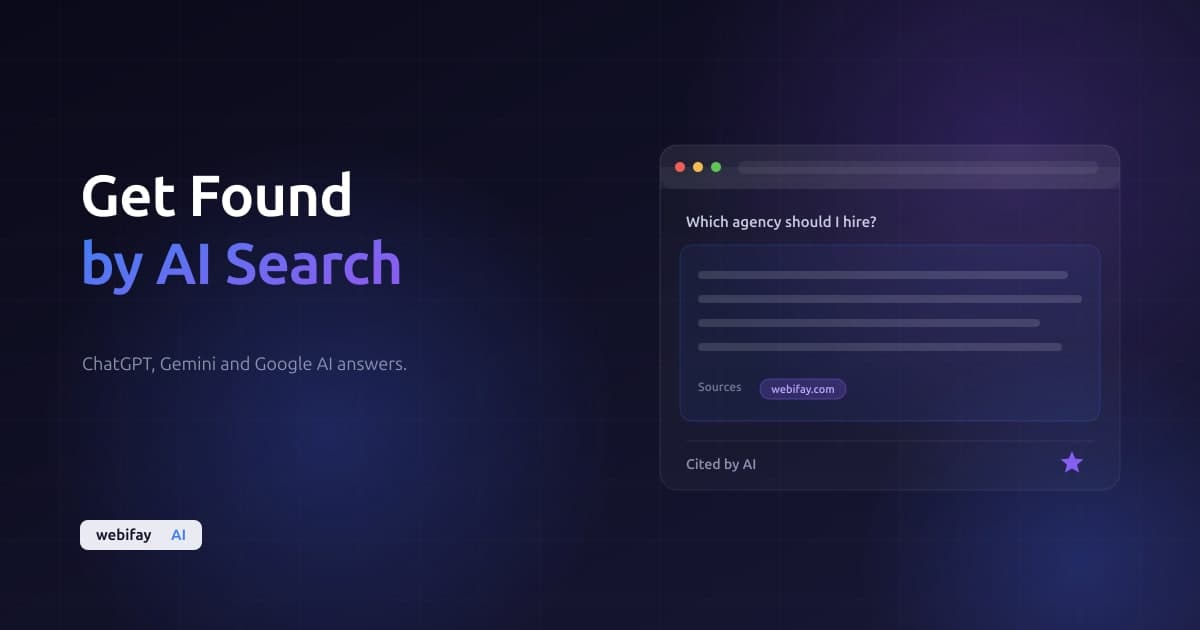
The industry is busy naming this — GEO, AEO, "answer engine optimisation" — and doing its usual acronym circus. Here's the practical version: the goal is that when an AI answers a question about your sector, it uses your website as a source.
The good news: it isn't a discipline running parallel to SEO. It's the same SEO with a higher bar on a few specific things.
There's no secret switch that puts you in ChatGPT. There's clear, well-structured, verifiable content — which happens to be exactly what Google has been asking for over the last decade.
How an AI decides who to cite
Simplifying a lot, three filters apply in sequence:
- It has to be able to read you. If your site takes six seconds to load, hides its content behind heavy JavaScript or blocks crawlers in
robots.txt, you don't survive the first cut. - It has to understand what you're talking about. AI looks for concrete answers to concrete questions. A services page saying "we're leaders in integrated solutions" answers nothing. One saying "an online store costs between X and Y, and here are the five factors that move the price" answers plenty.
- It has to trust you. Reviews, mentions elsewhere, a consistent business profile, visible authorship, facts that can be checked. What we've been calling authority for years.
The biggest shift from classic SEO
You used to optimise a page for one keyword. Now you want to cover the whole question and everything around it: what it is, what it costs, how it works, how it compares, what happens if you skip it. AI feeds on pages that close a topic, not on pages that brush past it.
Six things you can do this month
None of this needs a rebuild. All of it needs sitting down and writing properly.
- Answer the question in the first two sentences. No three-paragraph warm-up. The AI — and your reader — want the answer up top and the detail after.
- Use headings that are real questions. "How long does it take to rank a new website?" beats "Timelines". Write the way your customer talks, not the way your industry talks.
- Include numbers, ranges and dates. A price, a timeframe, a percentage. AI answers lean on the specific and skip the vague. We do it ourselves in how much SEO costs in 2026.
- Mark your content up with structured data. Schema markup tells the machine what each thing is: an FAQ, a price, a review, a service. It's reading your page out loud, slowly.
- Keep your Google profile sharp. It's still one of the most-cited sources for anything with local intent. If yours is half-finished, finish it.
- Let the crawlers in. Check that your
robots.txtisn't blocking AI bots by default. Plenty of templates block them without anyone having made that decision.
What doesn't work (but will be sold to you)
Agencies are already promising "guaranteed ChatGPT ranking". Same film as "first page of Google in 30 days", new set design.
✅ What actually moves the needle
- Content that genuinely answers
- Verifiable, up-to-date facts
- Clear, semantic structure
- Real reviews and mentions
- A fast, crawlable site
❌ Smoke
- "Guaranteed placement in ChatGPT"
- Stuffing pages with keywords
- Mass-generated text with no judgement
- Buying mentions from link farms
- Rebuilding your site for every new acronym
The uncomfortable part: fewer clicks
Worth saying out loud: if the AI answers well, a lot of people won't visit your site at all. That's already happening and no clever trick reverses it.
The practical consequence is that the traffic that does arrive is worth more. It arrives better informed and further down the funnel. Which makes it even more important that the page it lands on is built to turn that visit into a customer, not just to add a number in Analytics.
And watch what it says about you
Ask ChatGPT and Gemini about your business and your sector in your city today. Sometimes the surprise isn't that you're missing — it's that you're there with three-year-old information. Fixing that starts by publishing the correct version on your own site.
So is SEO dead?
No. The shop window changed, the work didn't. The sites cited in AI answers are almost always the ones that already ranked well: fast, clear, honest, with a reputation behind them. If you have that, you're ahead. If you don't, start with the fundamentals of ranking rather than with the acronym of the month.
Your next step
Look yourself up in an AI. If what comes back doesn't represent you, you have work to do — and it's work you can measure.
At webifay we approach search positioning with this scenario already in mind: content that answers, structure machines understand, and a site fast enough to be read. Tell us about your case and we'll tell you, without the smoke, where you stand.